



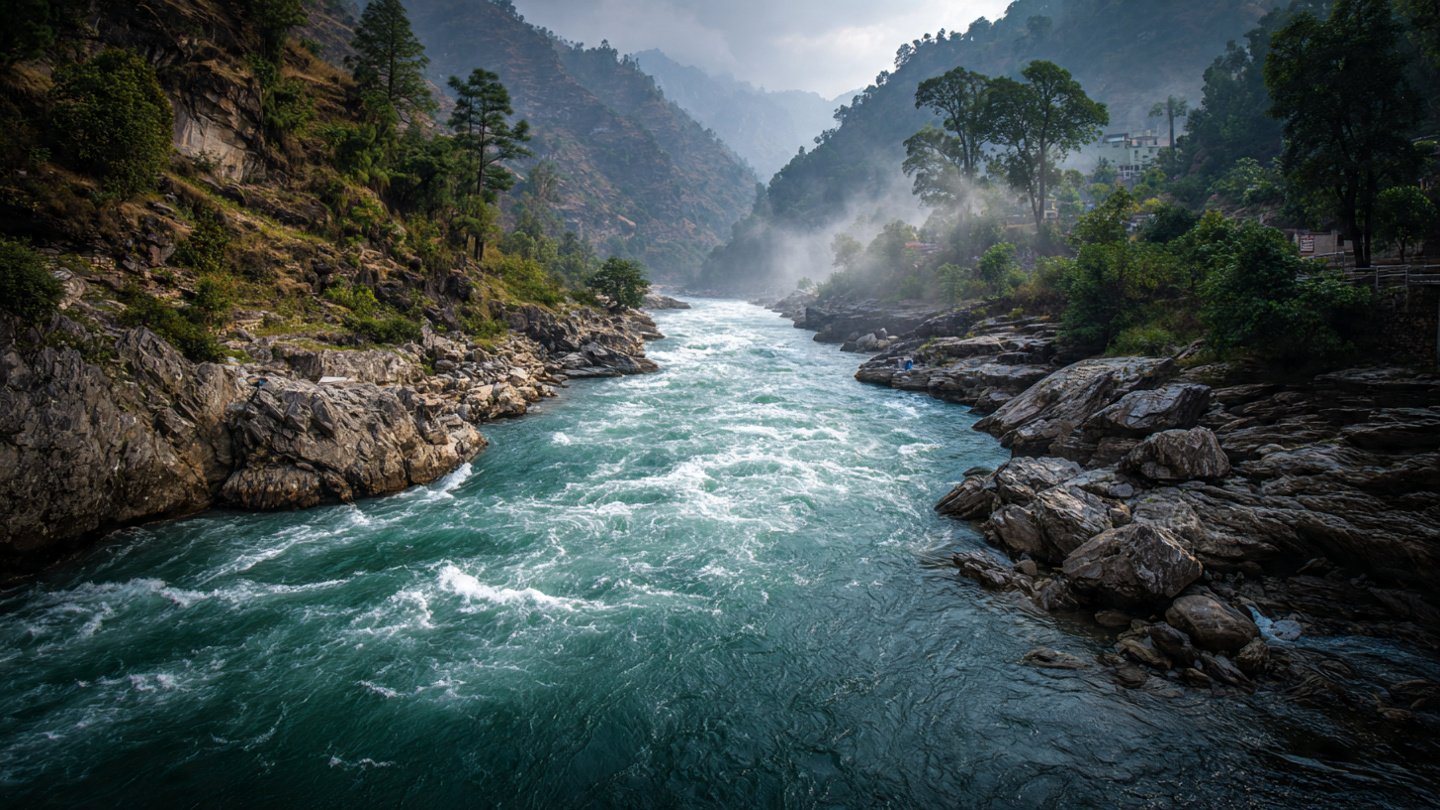
The Parushni River, known today as the Ravi, was one of the most dangerous and powerful rivers of the Rigvedic age.
Its violent floods played a decisive role in the famous Battle of Ten Kings, helping the Bharatas emerge victorious.
Discover how this mighty river got its name and why it was feared across ancient India.
The Paruṣṇī River known today as the Ravi flowing through Himachal Pradesh, Jammu, and Punjab in India, it holds deep cultural and spiritual significance and is frequently referenced in ancient Indian scriptures for its role in shaping early civilization and Vedic history.
It was one of the most feared and powerful rivers of the Rigvedic age, and its force was so immense that it literally changed the course of history.
In ancient times, this river was not a gentle, flowing stream but a wild and unpredictable natural force, famous for sudden floods, violent currents, and destructive overflows.
Because of this fierce nature, the Vedic people gave it the name Paruṣṇī, a Sanskrit word meaning harsh, raging, or violently flowing. The name itself reflects how dangerous the river was to anyone who tried to cross it.
This terrifying power of the Paruṣṇī became a decisive factor during the legendary Dasarajna Yuddha, the Battle of Ten Kings, one of the most important wars described in the Rigveda.
In this great conflict, King Sudas of the Bharata tribe faced an alliance of ten powerful rival tribes.
When the enemy forces attempted to cross the Paruṣṇī to attack the Bharatas, the river suddenly flooded.
Its raging waters swept away warriors, chariots, and supplies, throwing the enemy armies into chaos. What no army could achieve with weapons, the river accomplished with its natural fury.
The Rigveda even praises this event as a divine intervention, where the river, under the will of the gods, especially Indra, turned into a weapon for the Bharatas.
The enemies were drowned and scattered, and King Sudas emerged victorious, establishing the dominance of the Bharata tribe in the Vedic world.
ALSO READ: What was the Battle of Ten Kings?
This is why the Paruṣṇī is remembered not just as a river, but as a living force that shaped the destiny of ancient India.
Over time, as languages and cultures evolved, the Paruṣṇī came to be known as Iravati, and later as the Ravi, but its ancient identity as the “raging one” never faded.
Its story reminds us that in the Vedic age, rivers were not just sources of water they were powerful entities capable of protecting kingdoms, destroying armies, and deciding the fate of history itself.
GEOGRAPHICAL OVERVIEW
The Iravati River originates in the Bara Banghal basin, a branch of the Dhauladhar Range in the Kullu District of Himachal Pradesh.
From its high-altitude source, it flows through the scenic Chamba Valley, following a generally north-westerly course.
Along its journey, the river is strengthened by two major tributaries—the Budhil and the Tundah—which significantly increase its volume and flow.
After this confluence, the river cuts through a narrow and dramatic gorge near Chhatrari, a place renowned for the ancient Shakti Devi Temple, before emerging into broader terrain.
Continuing its journey, the Iravati flows for nearly 40 Kms, forming a natural boundary along parts of Jammu, and finally enters the Gurdaspur District of Punjab, where it becomes part of the wider river system of northern India.
CULTURAL AND HISTORICAL SIGNIFICANCE OF PARUSHNI RIVER
The Iravati River occupies a place of profound cultural and spiritual significance in Hinduism.
In the Rig Veda, one of the oldest and most revered Hindu scriptures, it is known by its ancient name Paruṣṇī and is invoked with deep respect as a powerful and sacred river.
Its presence in the Rig Veda highlights not only its physical importance but also its divine status in the Vedic worldview.
Beyond the Rig Veda, the Iravati is also mentioned in several classical Hindu texts such as the Vayu Purana, Kalika Purana, and the great epic Mahabharata, all of which emphasize its sacred nature and historical relevance.
These references connect the river to rituals, pilgrimages, and the spiritual geography of ancient India.
The Iravati is further woven into Hindu mythology through powerful legends, including the divine journey of Shiva from Varanasi to Haramukha, a sacred passage believed to have taken place along or near its banks.
Through these scriptures and legends, the Iravati is remembered not merely as a river, but as a living, sacred force that shaped both the spiritual and cultural landscape of ancient India.
PARUSHNI RIVER IN MODERN CONTEXT
Today, the Iravati River is valued not only for its deep spiritual heritage but also for its vital ecological and economic role in northern India.
The river continues to sustain local agriculture, nourishing farmlands and orchards, and serves as a crucial water source for communities that depend on it for daily life, irrigation, and livestock.
Along its banks lie many ancient temples, pilgrimage sites, and historic towns, reflecting centuries of continuous cultural life.
Among these is Chamba, a town celebrated for its exquisite wood carvings, traditional temples, and classical Himalayan architecture.
Together, the living river and these heritage settlements form a unique blend of nature, history, and spirituality, making the Iravati not just a river, but a lifeline that continues to shape the cultural and environmental landscape of the region.